Give the reader
a little room.
Write AI-assisted website copy that helps someone understand the offer, check the facts and decide what to do next.
Published · Updated
Imagine asking someone whether they can fix your fence. They tell you about their property boundary restoration workflow.
Good. But can you fix the fence?
It’s easy to do this with AI. Ask for concise, professional copy and you can get a sentence with every spare word removed. The reader gets to put them back in their head.
I want our writing to leave enough room for someone to follow the thought. Sometimes that means another sentence. Sometimes it means naming the person doing the work.
Fewer words can leave more work.
A recent preprint by Thomas Hikaru Clark, Matias B. Martin and Kyle Mahowald, Why is AI-generated language so hard to understand?, looks at sentence patterns associated with reading difficulty. Many tested models favored dense phrasing, with differences across models and tasks. In one experiment, a penalty on answer length changed how a small model built its sentences.
The study uses linguistic indicators, not a new human reading test. It doesn’t measure customer engagement, Google rankings or AI citations. Its explanation for frontier-model behavior remains a hypothesis.
My practical takeaway: when I ask an agent to be brief, I still need to check how much work I’ve handed the reader.
Let someone do something.
A page might offer a “source-backed offer eligibility review.” I can unpack that, but I’d rather start here:
We check whether AI gives people the right information about your offer, including who it won’t work for.
There’s a person doing a job. There’s a reason for the job. You can decide whether you need it.
Technical names can come after the idea. SEO is useful shorthand once we’re talking about helping customers find a page. AEO needs an explanation when the reader has never heard of it. Familiar words, a good metaphor or a little play can help. We don’t have to sand every sentence flat.
A clear answer still has to be right.
We tested a phone-only question about our own Agent Setup Kit. A Google AI Overview cited our daily-brief guide and promised cloud execution. The local workflow in that guide needs a computer and app available.
The answer sounded helpful while describing something the kit didn’t include.
We made the phone-only explanation more direct. That section opens with the answer, then explains the computer requirement and what the $20 kit includes. A source correction is something we can verify. Whether an assistant changes its answer needs a later check.
That’s useful discipline for ordinary website copy too. Give the answer where someone expects to find it. Keep the important requirement close enough that they won’t miss it.
Show me the thing I’m supposed to understand.
“We maintain correction continuity” is quite a thing to say. Here’s the smaller version we can show.
In a fictional fence example, the first draft priced twelve panels. We supplied a practice correction: two panels were staying. The revised draft changed the count to ten and the known-line subtotal from $1,920 to $1,620. The final total stayed unknown because important details were missing.
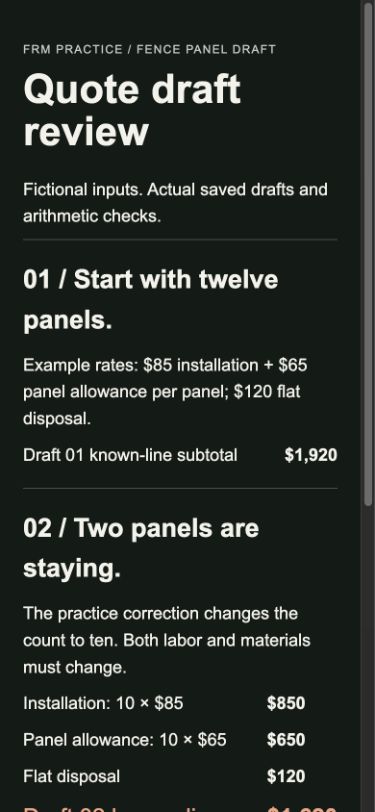
You can open both drafts and check the arithmetic. That gives you something to judge. It also shows where you still need to make a decision.
The same habit helped our handbook example preserve an unknown refund policy and our inquiry review keep a contact stop out of the reply queue. These were controlled practice exercises. Their value here is that you can inspect what happened.
Keep search and the reader in the same conversation.
Use the words someone would use to ask for help. Put a direct answer near the relevant question. Explain the offer, the requirements and the next step in visible text.
Google’s guidance for AI search features keeps ordinary SEO foundations in place: helpful content, accessible text and useful links. It requires no special AI file or schema. That guidance doesn’t establish a ranking benefit from any particular writing style.
For our pages, I’d start with the decisions people need to make. Can this run on my phone? What does the price cover? What will I need to check myself? A clear answer to a real question earns its place.
Try one paragraph before rewriting the site.
Take a paragraph from your offer page. Keep the facts, prices and limitations. Ask your agent:
Rewrite this so a person unfamiliar with our work can follow it on the first read. Name who does what. Unpack dense phrases when they obscure the meaning. Keep useful technical terms and explain them. Preserve every material requirement, exclusion and unknown. Keep our voice; don’t add a personality costume. Show me what changed and what you may have lost.
Then ask someone to tell you what they think you sell, who it fits and what happens next. Watch for the point where they have to guess. If no reader is available, the rewrite is still a draft awaiting that check.
An assistant’s summary is another useful check. It can reveal a missing requirement or a muddled offer. Record its answer separately from what a person understood; neither one proves a sale.
Read the paragraph aloud. Leave in the detail that helps someone picture the work. Keep the small joke if it belongs. Let a sentence stretch when the thought needs it.
The reader came to find something out. Give them enough room to get there.