Did your AI agent
finish the job?
The computer says “Done.” Good. Open the thing.
Published · Updated
If you asked for a quote, read the quote. If you asked for a website change, open the page on your phone. If you asked for a reminder tomorrow, check where it was saved and when it will run.
An enthusiastic final message is a pleasant sound. The result needs its own inspection.
Give “done” an address.
Before starting a job, say what should exist at the end and where you expect to find it.
“Help with our inquiries” is a large and rather foggy assignment. Try this:
Make a draft follow-up list from these inquiry notes. Put the customer’s request, missing information and proposed next action in a table. Link each row to its source. Save the list in this project. Leave every message unsent.
Now you have something to open and a few concrete things to check. Did each inquiry survive? Can you find its source? Did the agent invent a deadline? Are the messages still drafts?
You can make a useful first job this small. The computer will survive the indignity.
Change one fact.
A clean first draft is encouraging. A correction tells you more about whether the work hangs together.
Our fictional fence-quote exercise starts with twelve panels. The practice rates are $85 for installation and $65 for the panel allowance, per panel, plus $120 disposal for the whole job. Those supplied lines add up to $1,920.
Then two panels stay. Both panel-based lines must change. The revised subtotal is $1,620. Disposal stays flat.
The interesting mistake is $1,750: labor has changed to ten panels while the allowance still covers twelve. It looks quite respectable until you inspect the line items.
Try the free correction challenge
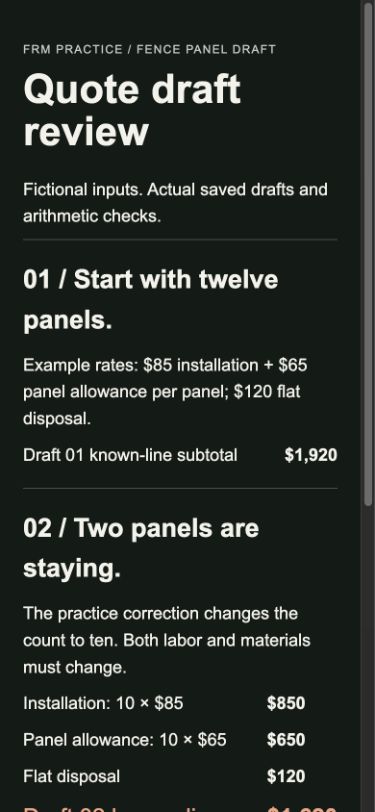
This is the saved output from our practice run, rendered in a phone-sized browser view. The agent wrote two drafts; a separate arithmetic check passed for both. We did not send a quote or measure time saved. You can inspect the source notes, saved drafts and arithmetic check, then try the correction with your own AI.
Keep unknown things unknown.
That $1,620 is a known-line subtotal from invented practice prices. It is not a customer’s final price. Measurements, materials, post condition, taxes and permits still need checking.
A useful draft can carry an unanswered question. In fact, that question may be its most valuable line.
Give the agent a place to put missing information. Ask it to name the source it used and to stop before making a promise the source does not support. Then inspect whether it followed those instructions.
Check the action separately.
Saving a draft, sending a message and someone receiving it are different things.
Before anything leaves your business, agree what the agent may do and what needs your review. After an authorized action, check the destination itself: the saved file, the published page, the sent message or the scheduled task. If the result is unclear, reconcile it before trying the action again. A second attempt can create a second copy or send.
A screenshot can help you review. An editable file, a source link and the actual destination make a better handoff.
Give the next conversation a place to start.
Save the approved correction with the work. In a fresh conversation, ask the agent to find the current source and use it in another draft. Check that it found the right version.
That is a practical return test. You are learning whether the workspace helps you resume a job, rather than asking the agent whether it remembers you.
Here is a small handoff you can keep:
Job: What did we ask it to finish?
Result: Where is the actual file or destination?
Sources: Which facts controlled the work?
Correction: What changed, and where is that saved?
Still open: What needs a fact, decision or permission?
Next time: Where should the next conversation start?
The Fort Rock Media Agent Setup Kit gives you a guided place to start with your business facts and a useful job. It is $20 once and requires your own ChatGPT plan with Codex and a Mac or Windows desktop. Personal help is optional and arranged separately.
Start with something you can check. Then give the computer another assignment.