BOOMSCROLLING / FOR LURKERS
Turn lurking
into working.
You already have a take. Give it somewhere to go.
A heron standing in the shallows looks like it’s doing nothing. One leg up. Very still. If you didn’t know better, you’d think it was waiting for a bus.
It’s lurking. It’s also working. You find out which one at dinner.

Most of the internet is lurkers.
Back in 2006, Jakob Nielsen wrote down a rule of thumb for online communities. Roughly 90% of people read and never contribute, 9% chip in now and then, and 1% account for most of what gets said. He called it participation inequality. For blogs, he figured the split was even steeper.
Those are old numbers and they move around from place to place. But anybody who has watched a comment section knows the shape. A few people talk. Everybody else reads.
The usual way to read that rule is that 90% of people are passive. I don’t think that’s right.
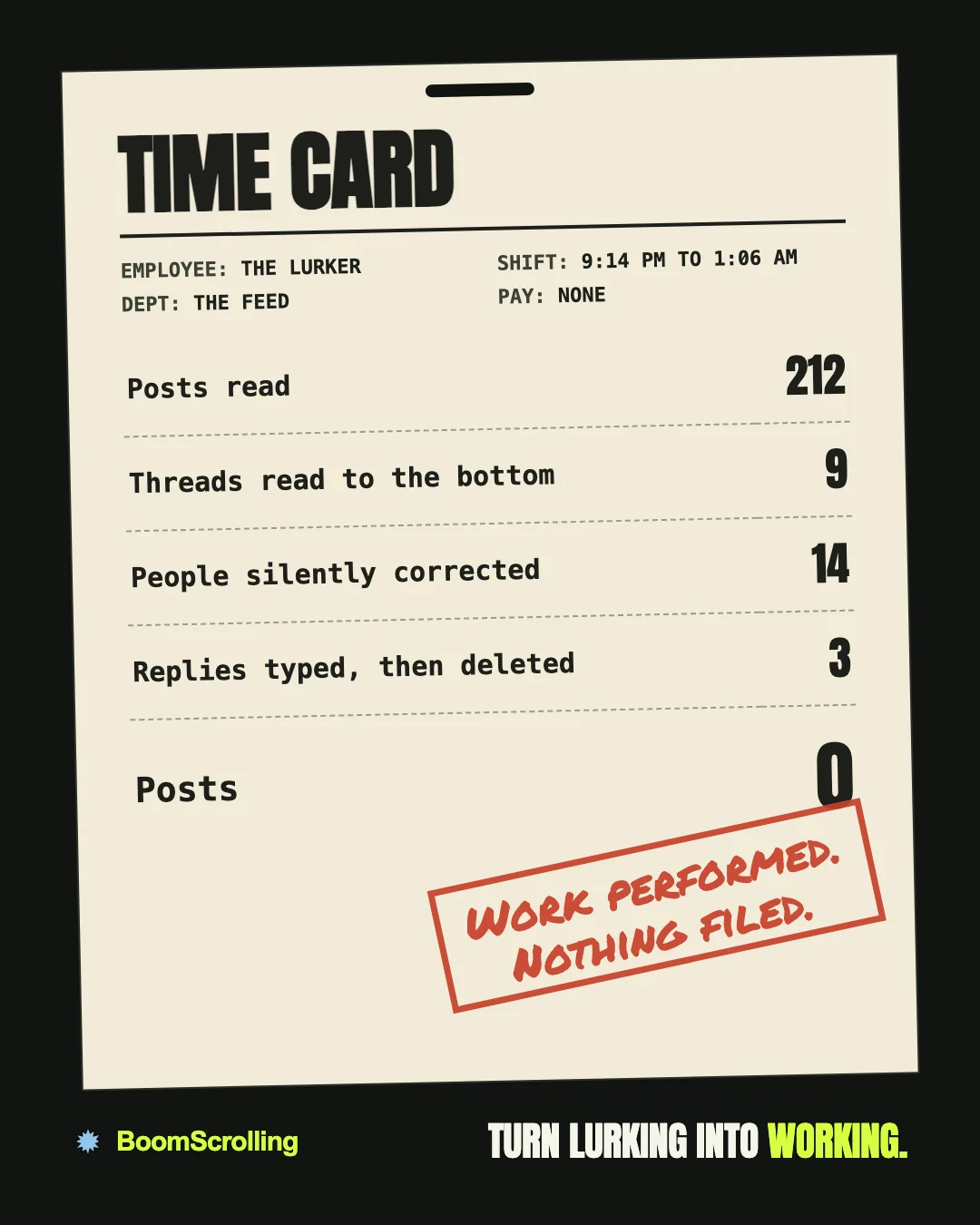
Lurking is already work.
Look at what a good lurker actually does all day. They read the whole thread, including the replies. They notice the comment that’s wrong in an interesting way. They know which account always says the same thing and which one occasionally knows something. They have a take on the take.
Write that down as a job description and it sounds like a job. Research. Judgment. Editorial taste. Some people have been doing it every night for fifteen years.
It just doesn’t leave anything behind. The like button is about the only receipt, and a like doesn’t say what you thought.
A blank box is hard. A draft gives you something to fix.
Here’s the part I find interesting. Ask a lurker to write something from scratch and they freeze. Show them somebody else’s sentence and they’ll tell you exactly what’s wrong with it, in detail, possibly with a diagram.
That isn’t a lack of opinions. Lurkers have been reviewing the internet for years. They just never filed the notes.
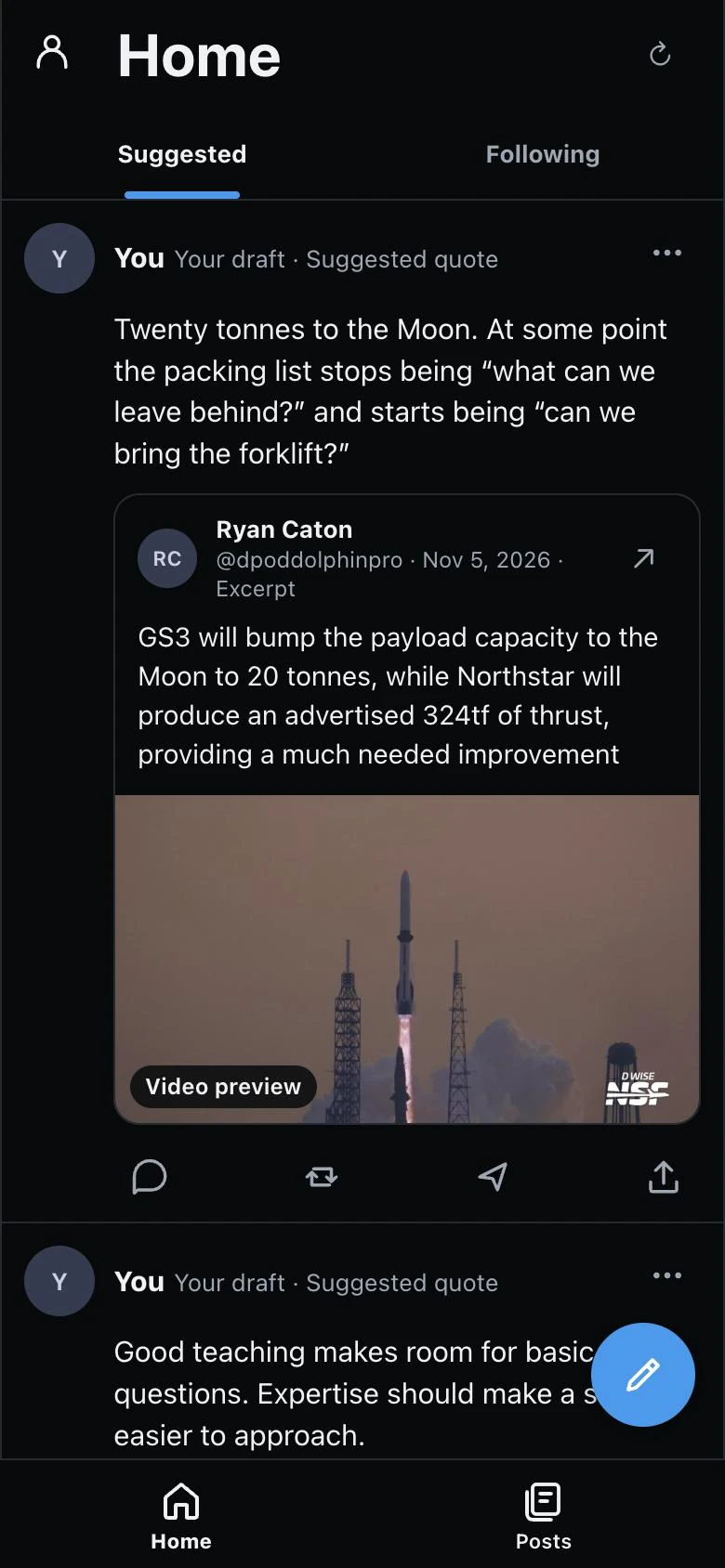
So BoomScrolling doesn’t start you with a blank box. It starts with a real post and a suggested response, which hands a lurker the one job they’re already great at.
A post shows a robot mowing a lawn.
The suggested response: “This is a game changer.”
You change it to: “Finally, someone else can mow while I supervise from the porch.”
You didn’t have to invent a post from nothing. You saw a suggestion, knew what you’d say differently and made it yours. Keep it, change it or pass. The draft is a starting point, not the thing you have to say.
Working like a radio works.
I should be careful with the word “working.” I’m not trying to turn the one relaxing thing you do into a second job. Fort Rock Media’s whole line is more growth, less grind. A feed full of homework would be worse than the feed you already have.
I mean working the way a joke works, or a radio. It does the thing it’s for. The reading you already did turns into a sentence that exists somewhere outside your head.
Sometimes that sentence is a joke. Sometimes it’s the correction somebody needed. If you run a business, it might be the reply you’d give a customer if they asked you directly. An electrician who reads every “why does my breaker keep tripping” post in a local group already knows exactly what people are confused about. That’s research. A good reply is the research showing up.
Whether a reply like that turns into customers, I don’t know. That would take evidence, and it’s early. It’s still a better use of the reading than nothing.
Your taste isn't your public voice.
You can enjoy a ridiculous argument without wanting it on your business account. You can admire a joke and have no interest in telling it yourself.
So “you liked this” cannot mean “you want to publish this.” Those are different decisions.
Read the source. Check the facts. Keep your own level of seriousness. Edit or pass. A good tool should leave you more willing to stand behind the words.
Not everybody has to post.
I don’t want to recruit the whole 90% into the 1%. The internet does not need ninety million more confident men. Some of the best people online are the quiet ones, and listening is a real skill. Lurking is a fine way to spend an evening.
The idea isn’t that you should post more. It’s that when you’ve already done the reading and you do have something to say, it shouldn’t die in the reply box. One good sentence a week is plenty. Pass on the rest. Pass is a button. Use it a lot.
What’s actually here.
The early version is free. Open the feed without signing in and you get a prepared selection of real posts, each with suggested responses. Change the words, keep a response or pass. Sign in with ChatGPT when you want to save your drafts. No card.
When something’s ready, choose Continue in X, check it there and send it yourself. Nothing posts automatically. The starter feed isn’t your personal Following feed, and it doesn’t watch what you like on X.
For the plain walkthrough, read You’re scrolling anyway. Leave with a post. For where it came from, read why we made it. For what makes a reply worth sending, read Reviews from the back row.
Give the habit something to do.

If you’ve been reading for years, you’ve done the hard part. Try one conversation. Keep a response, fix it or throw the whole thing back.
And if you’d rather keep lurking, that’s fine too. Tell me what you’d change. You clearly have notes.