One more flake
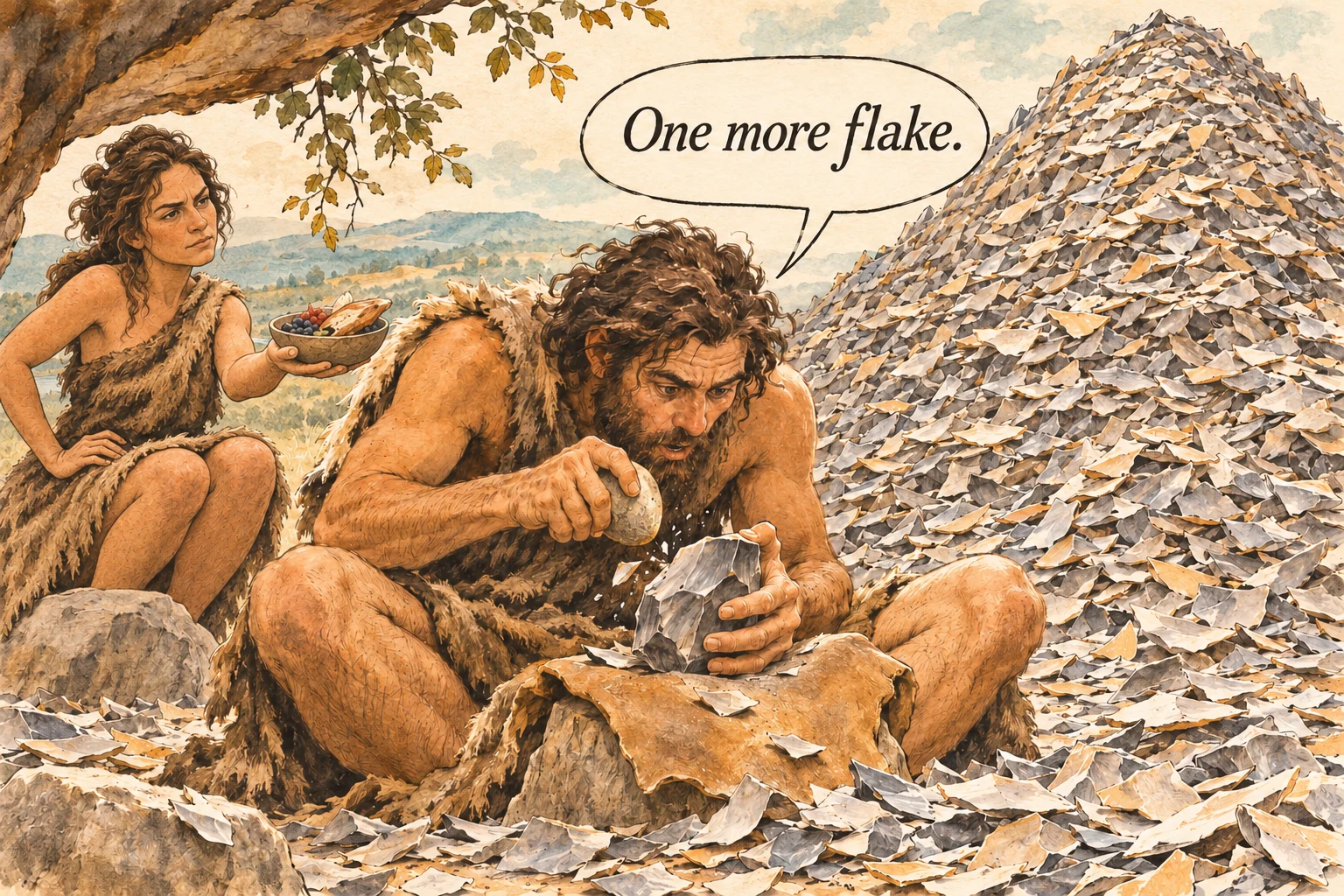
Maybe our weakness for “one more” is older than the screen. The rocks weren’t learning from us.
In Stone Age Code, I wrote that I kept all my social media apps in a folder on my phone labeled “Dopamine.” Each time I opened it, I would be reminded of what I was doing.
The next sentence was: “It doesn’t help, I still scroll.”
There’s something disappointing about knowing why you do a thing and doing it anyway. You’d hope that naming the folder would count as treatment. At least a little.
I’ve been thinking about this habit for a while. Long enough to have put it in a book about our prehistoric ancestors, who also spent a considerable amount of time hunched over little objects.
I suspect the fascination goes deeper than phones, or even technology. A pattern to follow. A little thing to improve. The feeling that one more try might do it. Maybe some of that comes with being human.
The original screen time problem
Picture somebody making a stone tool. He turns the core over, studies the edge, hits it. A flake comes off. Pretty good. But he can see where the next one should go.
That one breaks badly. Now there’s a problem to fix.
Then a beautiful flake comes away, thin and sharp, and for a moment he’s the best person in the valley at something.
I suspect there were people who found this very hard to put down. Somebody calling them to dinner while they sat in a growing pile of sharp little achievements. “One more.”
In the book, I imagined a Neanderthal mother complaining about her son’s new flint-knapping technique: “Darn kids glued to their stones, they’re going to get tech neck!”
The piles are real. They don’t tell us whether anybody missed dinner.
At Grime’s Graves in England, a much later prehistoric flint-mining site, Bronze Age rubbish deposits contained six tonnes of worked flint, recycled from earlier waste dumps. That’s a lot of rock. It tells us about generations of mining and reuse, rather than one man having a difficult weekend. English Heritage describes the excavations.
Making stone tools produces debris, called debitage. Making useful tools, learning, making mistakes and coming back for more can all leave a lot of it. We can’t look at a pile and conclude that its makers were addicted, any more than we can diagnose a carpenter by weighing his sawdust.
But I’m happy to imagine the fellow who had already made a perfectly good tool and wanted to see if he could make a better one. I recognize the behavior. I write software.
A flake gives you an answer
One comparison I made in Stone Age Code was between the immediate feedback of programming and toolmaking. The code runs or it fails. The flake comes off cleanly or you break the thing you’ve been working on.
There’s a result, and the result suggests another attempt.
This is also how you get good at something. I don’t want to turn every absorbing interest into a disease. We owe quite a lot to people who were willing to sit still and be unusually interested in a rock.
Researchers have taught modern people to make stone tools and studied how they think about the work. In one small study of six people, planning a handaxe took effort: keeping track of what they were doing and what should happen next. That tells us something about skill, not ancient addiction. Stout and colleagues, 2015.
Doing it again can get you somewhere. You make a blade. You fix a bug. You learn a song. Eventually there’s something you can use, or enjoy, or show somebody.
The rocks weren’t learning from you
Here’s where the comparison changes. The rock could reward your effort with a beautiful flake. It couldn’t notice what held your attention and rearrange the next thing you saw.
A personalized feed can. TikTok, for example, describes using what you watch, finish, like and share to help decide what to show you next. Its own explanation is quite plain about this.
You were learning how to work the rock. The feed is learning what works on you.
Your thumb can keep going
The next post might be wonderful. A strange animal. A good joke. Someone explaining a thing you’ve never understood. Someone misunderstanding a thing you could explain if he would just listen.
There’s enough genuine pleasure in there that I don’t find “phones are bad” a very interesting explanation. I like the animals. I even like some of the people.
The trouble is the ease of carrying on after the part you wanted is over. An endless feed doesn’t give you the last page of a chapter. Your next movement is the same as your previous one. You barely need to decide.
And when you post, the response can become another reason to return. In a 2021 study, researchers analyzed more than a million posts from over 4,000 people. The likes they received helped explain when they posted again. In a separate experiment with 176 people, changing the rewards changed how quickly people posted. Lindström and colleagues.
The study was about posts and likes. It doesn’t prove that every scroll is a dopamine hit or that everyone is addicted. It does make me cautious about selling “post more” as the answer to “I can’t stop checking.”
You can escape the audience and immediately become a performer checking the audience.
I use “scrolling addiction” here for that familiar loss of control: continuing when you meant to stop, especially when it starts taking things you care about. Spending an enjoyable hour online is not, by itself, evidence that something is wrong with you.
A nicotine patch for your thumb
You were going to scroll anyway. I’d like you to come back with something of your own.
That’s part of why we made BoomScrolling: to give a familiar habit a more satisfying place to end.
I think of it as trying to build a nicotine patch for scrolling.
A patch starts with the person who still wants a cigarette. It doesn’t require them to become a different person before breakfast. I like that.
Real nicotine patches supply nicotine without cigarette smoke, ease withdrawal, and have good evidence that they help people quit. BoomScrolling hasn’t been shown to reduce compulsive use or screen time. I’m borrowing the idea. The app still has to prove it helps. The evidence for actual nicotine replacement is here.
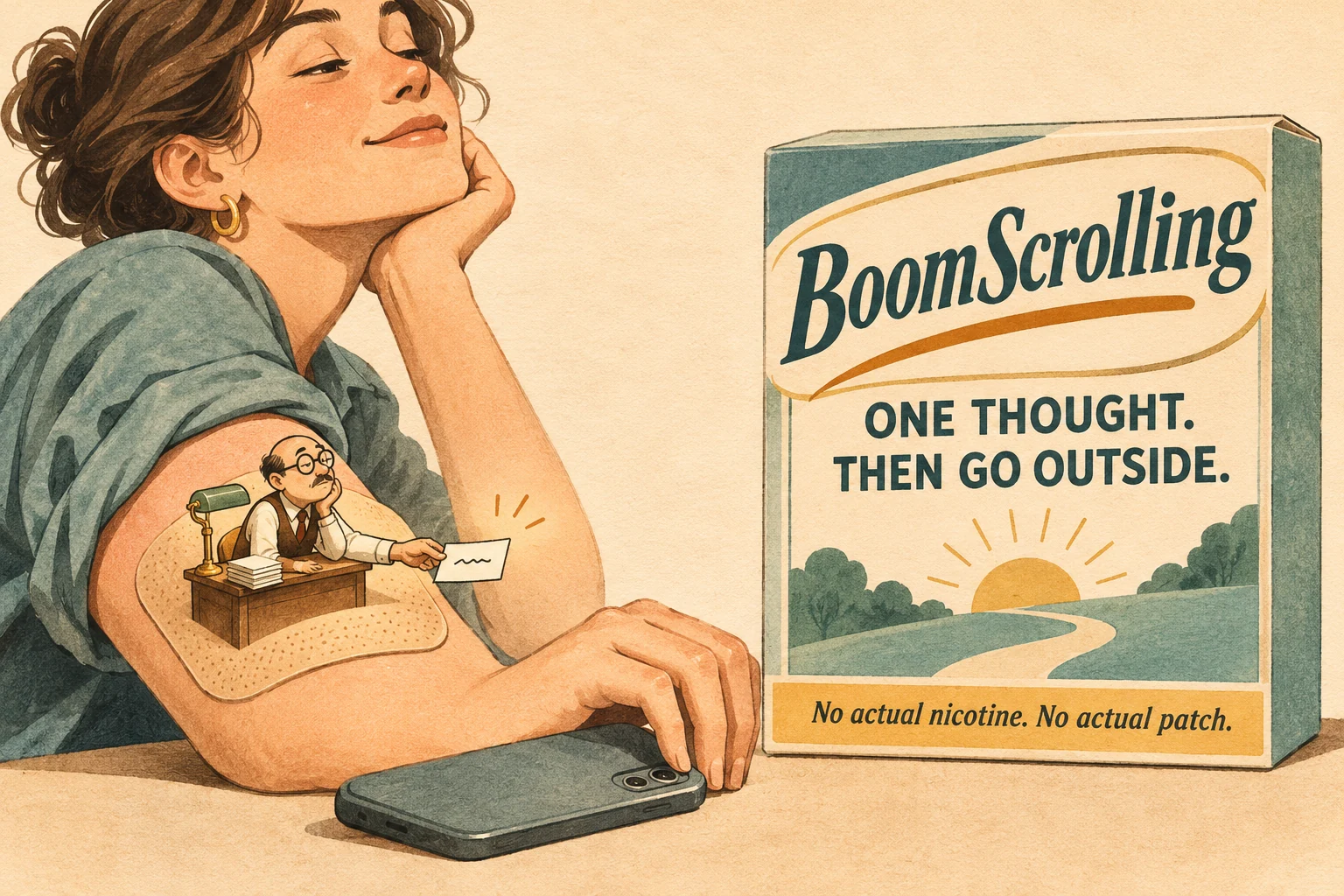
In BoomScrolling, you read a real post and consider a suggested response. Change it until it says what you mean. Keep it, save it, or pass. If you use the free app to post, you take the draft to X and decide whether to send it there.
A draft gives you something to work on. “That isn’t quite what I think” is often an easier beginning than a blank box demanding an original thought.
Maybe you know the subject and can add something. Maybe the suggestion is too confident, and editing it helps you discover the question you actually have. Maybe you read it and decide there’s no reason for you to be involved.
That last one counts. The man is allowed to be wrong without receiving a personal visit from you.
I’d like people to come back from the feed having made one choice they feel good about. A little making, then an opportunity to leave. The current app doesn’t enforce that departure with a timer or block X. We still have to find out whether people leave when they meant to.
The patch has to earn its name
There’s some encouraging research on making it easier to stop. In a trial of 467 people, researchers randomly assigned when people would block the internet on their phones for two weeks. The study found improvements in attention, mental health and well-being. Calls and texts still worked, and people could use the internet on other devices. But only 119 people kept the block on for at least 10 of the 14 days. Even people who volunteered had trouble following through. Castelo and colleagues, 2025.
A smaller interruption can matter too. Researchers studying the app one sec ran a separate experiment with 500 people. Giving people a chance to skip a video before it started helped them watch less. A short delay helped too. The app’s creator helped write the study. That’s an idea we can learn from, not a result we can claim for BoomScrolling. Grüning and colleagues, 2023.
So does BoomScrolling help people get some choice back? Did the visit end when they wanted it to? Did they leave with something they meant, or just acquire another thing to check?
If we help somebody write one reply and they spend the next three hours refreshing it, I don’t want to celebrate the reply.
And if calling it “productive scrolling” gives somebody permission to do more of something that was making them miserable, we’ve supplied a better excuse. That isn’t harm reduction.
Reading can be enough. Laughing can be enough. You don’t owe the internet a contribution, and you don’t have to turn a habit into work before you’re allowed to stop.
I like the idea of helping the person in the pile of flakes make something they’re happy with.
Then somebody calls them to dinner.
And this time they go.
From Stone Age Code: the “Dopamine” folder appears in chapter 2, the toolmaking feedback comparison in chapter 5, and the imagined Neanderthal family in chapter 10. Related essay: The feed doesn’t know when you’re done.