Advertising starts
with the task.
Google search, AI answers and conversational ads can help people find your business. Each does a different job.
A business owner might ask an AI assistant how to turn scattered notes into a weekly brief. That conversation contains a problem, some constraints and a possible next step. An ad offering help with that particular job has a better reason to be there than “We do AI.” Whether it earns the click and the work is still an experiment.
Three ways to be found.
Google SEO helps people discover useful pages when they search. AI search visibility helps an answer engine find a source and accurately describe it. ChatGPT advertising buys a labeled placement that may fit the conversation.
OpenAI says ads remain separate from answers and don't influence them. Paying for an ad doesn't buy a recommendation inside the answer. Advertisers don't get the person's private chat. Read how ChatGPT ads work.
That distinction matters when someone offers “AI SEO.” Ask what they're actually improving: accessible pages, accurate business facts, linked citations, ad delivery or inquiries. Those are different results.
Give the ad a useful job.
A vague promise makes the reader finish the work. “Less busywork” sounds pleasant. It doesn't tell someone what they'll receive, what it costs or whether it fits their problem.
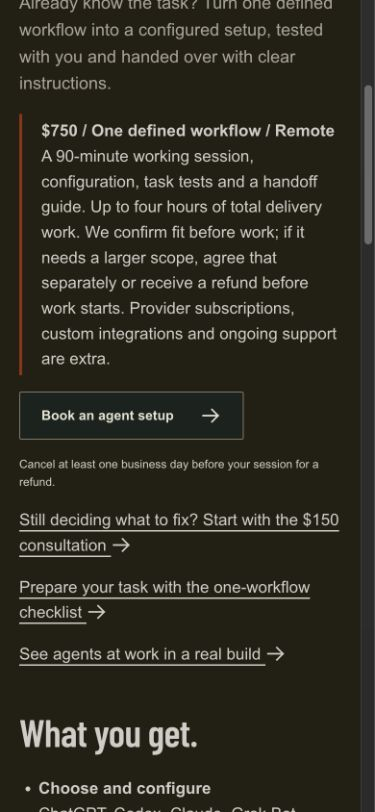
For our own setup offer, a clearer message is: AI Workflow Setup. One Task. Tested. The next line explains the deliverable: $750 for one workflow, task tests and a handoff guide. The landing page explains the scope and costs that are separate.
Other messages can start with repeated work or getting a half-configured workflow ready to use. Keep the offer and destination consistent so the comparison teaches you something. A clean image should reinforce that offer, with text you can still read in the displayed crop. A chopped-up homepage screenshot rarely helps.
Show the thing someone receives.
A screenshot earns its space when it answers a buyer’s question: what would I use, check or get back? A useful output, with enough context to understand it, can explain more than another paragraph about “AI capabilities.”
Claude Hopkins made a related argument in Scientific Advertising: pictures should strengthen the selling argument, and results should decide whether they help. Familiar screens give us a practical way to try that today. They still need an honest caption and a readable size. See chapters I, VII and IX.
Describe the moment, not just the keyword.
ChatGPT Ads Manager uses context hints to describe when an offer may help. Think: “A small-business owner has a repeated desk task and wants hands-on help configuring one workflow.” That's a situation, not a list of magic search terms.
Hints guide relevance. They don't enforce exact keyword matching, geographic boundaries or exclusions. Use the campaign's actual location controls for geography, and keep the hints faithful to work you can deliver. OpenAI's context-hint guidance explains the distinction.
Make the source worth finding.
Organic AI discovery still needs good source material. Say what you do, where you work, what it costs, what's included and who it's for. Answer real buyer questions. Publish demonstrations that show the work, with sources for claims and clear labels on made-up examples.
Google says its AI search features use the usual SEO foundations. There's no special AI file or schema you need to add. Accessible pages and useful information help establish eligibility; they don't guarantee a citation. Google's AI search guidance is refreshingly practical about this.
Check crawler access too. OpenAI has different crawlers for search discovery, training and ad landing-page checks. Treat those controls separately. Allowing a crawler doesn't prove it visited, indexed or recommended you. OpenAI's crawler documentation explains their roles.
Run a small experiment you can read.
Choose one offer, one landing page and a few useful messages. Set a total flight cap and dates. Check the saved settings, including automatic text changes, before starting. Test the page and inquiry route on a phone. Decide who responds.
Then count real things: spend, impressions, clicks, completed inquiries, suitable tasks, bookings and collected fees. A visit isn't a lead. A lead isn't paid work. Revenue isn't profit until you've counted delivery time and costs.
A platform may send more traffic to one creative than another. A handful of clicks won't prove which headline wins. Use the first run to find broken steps and learn whether the inquiries fit. Don't raise the budget just to make the dashboard more exciting.
Our own ChatGPT campaign work is at preparation: clearer messages, a specific offer and checks before spending. We haven't measured acquisition results from it. The point of testing on ourselves is to learn what actually holds up before recommending the method to a client.